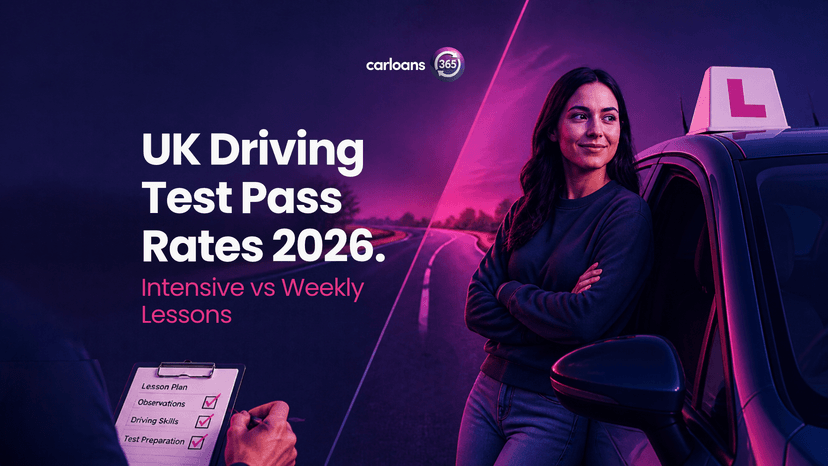

Driving test pass rates 2026: are intensive courses worth it?
Only half of UK driving tests are passed. See the latest DVSA pass rates, how intensive and fast-track courses compare, and the 2026 booking rules.
Sweaty palms, a stranger with a clipboard, and 40 minutes that feel like four hours. If you're dreading your driving test, you're in good company. Here's what the latest pass rates show, how weekly lessons compare with intensive and fast-track courses, and what to sort out before you buy your first car.
Only one in two learners passes their practical test. Nerves play a part, but so do booking too early, unfamiliar roads and simply not having enough time behind the wheel. With waits still stretching for months, a fail can cost you far more than the £62 test fee, so picking the right way to learn is one of the easiest ways to stack the odds in your favour.
In this guide
- What the latest UK driving test pass rates show
- Weekly lessons vs semi-intensive, intensive and fast-track courses
- Waiting times and the 2026 booking rules
- Tips for passing first time
- Getting ready to buy your first car
- FAQs
Quick answer
- The car practical test pass rate in Great Britain was 50% in the year to March 2026, and 50.5% for first-time candidates (DVSA data).
- Intensive and fast-track courses can get you test-ready in weeks rather than months, but they suit learners who already have some experience, can take time off and can secure a test date to match.
- For most beginners, regular weekly lessons topped up with private practice remain the safer route.
UK driving test pass rates: what the numbers say
Across Great Britain, 1,000,043 of the 1,998,621 car practical tests taken in the year to March 2026 were passes. That's a pass rate of exactly 50%, according to DVSA figures.
First-timers do slightly better than average. The first-time pass rate was 50.5%, from 984,415 first attempts. That also means more than half of all tests are resits, which is part of the reason waiting lists stay long.
Things may be improving. The DVSA's monthly pass rate hit 52.1% in August 2026, its best figure since spring 2021.
Manual vs automatic
Automatic tests are growing fast, but they're harder to pass. The automatic pass rate reached a record 44.6% in 2025/26, up from 37.5% in 2007/08, according to the AA. Around one in four AA and BSM instructors now teach in automatics.
If you learn in an automatic, your licence only covers automatic cars. That's worth knowing before you start looking at used cars, because it narrows your choice (although with more hybrids and electric cars on the market, that matters less every year).
Where you take your test matters
Pass rates vary hugely between test centres. Busy urban centres, especially in London, tend to have the lowest rates, while quieter rural centres often post the highest.
In Greater Manchester, 52,716 of the 108,750 tests taken across the area's nine centres between April 2025 and March 2026 were passes, around 48.5%. Chadderton was one of the toughest, with a pass rate of 46.8% (Oldham Chronicle).
Don't pick a centre purely for its pass rate, though. Since June 2026, you can only move a booked test to one of the three nearest centres, and you'll drive better on roads you know.
Weekly lessons vs intensive and fast-track courses
There's no single best way to learn. The right choice depends on how much experience you have, how much time you can free up and how quickly you need your licence.
Weekly lessons
One or two hours a week with the same instructor is still how most people learn. It's slower, but skills have time to sink in between lessons, and you'll see a wider mix of weather, traffic and times of day.
Best for: complete beginners, learners on a budget who want to spread the cost, anyone fitting lessons around work or college
Watch out for: losing momentum if lessons get cancelled or spread too thin
Semi-intensive courses
Semi-intensive courses pack lessons into a few sessions a week over a month or two. They're a middle ground: faster progress than weekly lessons without needing a week off work.
Best for: learners with a little experience who want a clear end date
Watch out for: courses priced as a bundle, which can cost more upfront than paying as you go
Intensive and fast-track courses
Intensive courses squeeze your training into one or two weeks of near-daily lessons, often several hours a day. Fast-track courses usually go further and aim to have you sit your test at the end, sometimes within days of finishing.
- Best for: learners who've already had lessons, have passed their theory test, and can clear their diary
- Watch out for: the test date. Since May 2026, driving schools can no longer book or move a test for you. You'll need your own booking, and if it doesn't line up with the course, you could be left waiting weeks after your last lesson.
Before paying for any course, ask what happens if you fail or aren't ready by test day. Check whether a refund, extra lessons or a free resit course are included, and get it in writing.
Crash courses for complete beginners
Some schools sell intensive courses to people who've never driven. It can work, but going from never having held a steering wheel to test standard in one week is a big ask, and tiredness sets in fast. If you're starting from zero, a short block of weekly lessons first will tell you how many hours you'll really need.
Waiting times and the 2026 booking rules
The DVSA carried out a record 2.13 million car tests in the 12 months to August 2026, and there were 50,000 more bookable slots on 1 September 2026 than a year earlier. Even so, only around 40% of August's candidates got a test within the DVSA's seven-week target.
The way you book has also changed this year:
- Since 31 March 2026: you can only make two changes to a booking (down from six)
- Since 12 May 2026: only you can book, change, swap or cancel your test. Your instructor, driving school or a booking service can't do it for you (GOV.UK).
- Since 9 June 2026: you can only move a test to one of the three nearest test centres
The rules are designed to stop bots and resellers snapping up slots, which should make it easier to get a fair-priced test. But they also mean you need to plan. Book your test as soon as your instructor thinks you'll be ready around that date, and use your two changes carefully.
Passed your test? Here's what comes next.
Whether you're months away or picking your first car next week, carloans 365 can help.
Tell us what you want to drive, and your adviser will help you find finance that fits around it.
Check your eligibility in around 60 seconds with no impact on your credit score.